Imagine trying to understand the contents of a sealed box without ever opening it. You could weigh it, shake it, or scan it with X-rays, but the holographic principle makes a bolder claim: by only measuring points on the box's surface, you can reconstruct everything inside—every particle, every field, every event—with complete fidelity. This idea, born from the peculiarities of gravity, has captivated theoretical physicists for decades, and it may force us to rethink the very nature of space.
Why Gravity Is Special
Gravity stands apart from the other fundamental forces. For electromagnetism, knowing the electric field on a surface doesn't uniquely determine the charges inside—positive and negative charges can cancel out, leaving no trace. But gravity is different: mass is always positive, so the warping of spacetime at a boundary uniquely encodes the distribution of mass within. As physicist Laurent Freidel of the Perimeter Institute puts it, this is why holography is plausible—gravity's one-way nature makes it possible to infer the interior from the boundary.
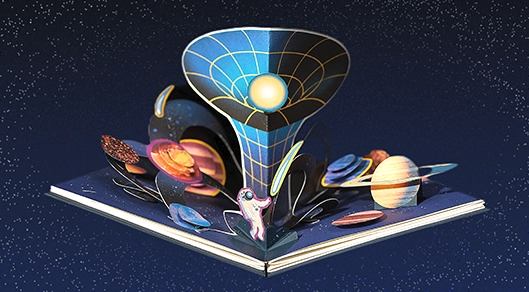
This uniqueness traces back to Einstein's general relativity, where mass curves spacetime. The curvature at the surface of a region reflects the total mass inside, and because there's no such thing as negative mass to cancel it out, the information is never lost.
Black Holes and Entropy: The First Clues
The holographic principle gained traction in the 1970s when Jacob Bekenstein and Stephen Hawking calculated the entropy of black holes. Entropy, a measure of the number of internal states, typically scales with volume. But their calculations showed that a black hole's entropy is proportional to its surface area, not its volume. This was a shocking result—it suggested that the information about everything that fell into the black hole is somehow encoded on its event horizon.
In the 1990s, Leonard Susskind at Stanford University took this further, proposing that a black hole is literally a hologram: all the information about its interior is contained on its surface. Gerard 't Hooft and Charles Thorn independently arrived at similar conclusions. Susskind admitted, "I thought it was a little bit crazy, but it was the least crazy of all possibilities."
The AdS/CFT Revolution
The idea gained concrete form with the discovery of AdS/CFT correspondence in the late 1990s, which posits a precise mathematical duality between a gravitational theory in a higher-dimensional space (anti-de Sitter space) and a quantum field theory on its boundary. This duality has become a cornerstone of theoretical physics, with the foundational papers amassing tens of thousands of citations. It's often described as "magical" and "miraculous" by researchers.
One of its most celebrated successes is resolving the black hole information paradox. Contrary to Stephen Hawking's original claim, black holes are not inescapable prisons—information can leak out, encoded in the radiation they emit, thanks to the holographic encoding.
What Does It Mean for Reality?
If the holographic principle holds for all of spacetime, then our three-dimensional world might be a projection of information stored on a distant boundary. This doesn't mean the world is an illusion, but it does suggest that space itself is not fundamental. As physicist Bartek Czech of Tsinghua University notes, it's like performing a CT scan of a brain without ever looking inside—just photographing the surface and reconstructing every detail.
This perspective has deep implications for quantum gravity, the long-sought theory that unifies general relativity with quantum mechanics. Holography hints that gravity and quantum mechanics are two sides of the same coin, and that space emerges from more fundamental quantum information.
But Is It True for Our Universe?
Most holographic studies have been conducted in anti-de Sitter space, a negatively curved spacetime that is not our own. Our universe is expanding and has a positive cosmological constant, making it closer to de Sitter space. Whether the holographic principle applies to our universe remains an open question. Some physicists argue that the principle is a mathematical fact, while others see it as a speculative leap. The debate is far from settled.
Still, the holographic principle has inspired a new way of thinking about the cosmos. It suggests that the universe might be like a neural network's internal model—a simplified representation that captures essential features but not the underlying reality. Or perhaps it's akin to new geometries in quantum mechanics that challenge our classical intuitions.
As physicists continue to probe the holographic principle, they are not just exploring a mathematical curiosity; they are questioning the very fabric of existence. If space is indeed holographic, then the universe we perceive is a projection of deeper information, and the mystery of reality only deepens.