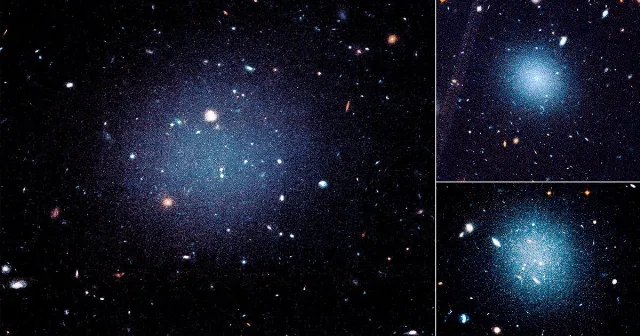
In the vast cosmic web, where galaxies are strung like beads on invisible threads, a peculiar trio of ghostly galaxies has emerged from the shadows. These ultra-faint, nearly transparent galaxies, located in a distant cluster, appear to be missing something fundamental: dark matter. Their discovery, reported by a team of astronomers, offers a powerful new clue in the ongoing quest to understand the universe's most elusive ingredient.
Dark matter, which outweighs ordinary matter by a factor of five to one, has never been directly detected. Its presence is inferred from its gravitational pull on visible matter and light. For decades, scientists have debated whether dark matter is a real, physical particle or a sign that our understanding of gravity is incomplete. The new observations, published in the journal Nature Astronomy, tip the scales decisively toward the former.
The three galaxies, each no more than a few thousand light-years across, are so diffuse that their stars are spread thinly, like a mist. Yet they are moving through the cluster at speeds that suggest they are being tugged by something massive. When the researchers measured their total mass, they found it matches the mass of the stars alone—no extra dark matter needed. In other words, these galaxies are almost entirely devoid of the mysterious substance.
A cosmic collision's aftermath
How could galaxies lose their dark matter? The leading explanation is a violent one. Billions of years ago, these galaxies may have been part of a larger system that collided with another group. During such a high-speed encounter, dark matter—which interacts only gravitationally—would have continued on its way, while the gas and stars, which feel electromagnetic forces, would have been stripped and left behind. This process, called ram-pressure stripping, is thought to have separated the galaxies from their dark halos, leaving behind only the visible remnants.
This scenario is not entirely new. In 2018, astronomers discovered a galaxy called NGC 1052-DF2 that appeared to lack dark matter, sparking intense debate. But subsequent observations were mixed, and some questioned whether the galaxy was truly anomalous. The new triplet, however, provides a more robust case, as the galaxies are in a well-studied cluster and their motions are more clearly measured.
Implications for gravity theories
The existence of dark-matter-free galaxies is a direct challenge to modified gravity theories, such as MOdified Newtonian Dynamics (MOND), which propose that the observed anomalies in galaxy rotation curves can be explained by tweaking the laws of gravity rather than invoking unseen mass. In MOND, dark matter is not needed; gravity simply behaves differently on large scales. But if a galaxy can exist without dark matter, and yet its stars move in a way that matches normal gravity, that is hard to reconcile with MOND, which would predict that the galaxy's gravity alone should produce the same anomalies as elsewhere.
As one of the study's authors, Yale astronomer Pieter van Dokkum, put it, "MOND would predict that these galaxies should have dark matter, because they are ordinary galaxies in every other way. The fact that they don't is a strong argument that dark matter is real."
A window into dark matter's nature
These ghostly galaxies not only support the existence of dark matter but also offer clues about its properties. The fact that the dark matter was stripped away suggests that it is not tightly bound to the galaxies, which is consistent with the idea that dark matter is made of weakly interacting massive particles (WIMPs) or other exotic particles that rarely interact with ordinary matter. If dark matter were something else, like a modification of gravity, the stripping would not have occurred in the same way.
Moreover, the discovery adds to a growing body of evidence that dark matter can be separated from galaxies in collisions. Similar examples have been seen in the Bullet Cluster, where the dark matter of two colliding clusters was left behind while the gas was stripped. This new case, however, is the first to show the effect on a much smaller scale, potentially giving astronomers a new tool to probe dark matter's distribution and behavior.
What lies ahead
The team plans to continue observing these galaxies with the James Webb Space Telescope and other instruments to confirm their findings and to search for more examples. Each new dark-matter-free galaxy provides a unique laboratory for testing the interplay between dark matter and ordinary matter. The more such objects we find, the better we can constrain the properties of dark matter, and the more we can learn about the violent processes that shape galaxy evolution.
For now, the triplet of ghostly galaxies stands as a striking reminder that the universe is full of surprises. What was once a theoretical possibility—that galaxies could exist without dark matter—has become an observed reality, and with it, a powerful new piece in the puzzle of what dark matter is and isn't.