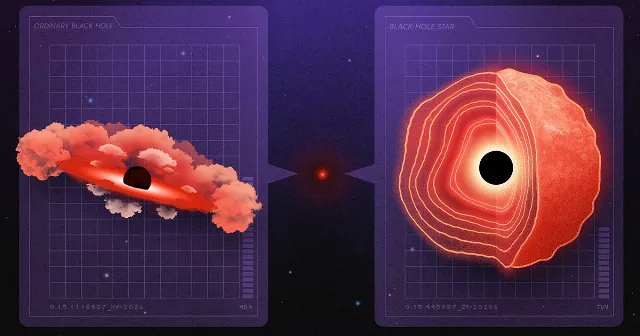
The James Webb Space Telescope has been uncovering a menagerie of oddities from the cosmic dawn, but few are as puzzling as the so-called “little red dots.” These compact, crimson-hued objects appear in abundance in the early universe, and their true nature has sparked a spirited debate among astronomers. Now, a provocative new hypothesis suggests that some of these dots might be colossal stars—each one dozens of times larger than our entire solar system—with a black hole lurking at its core.
The Little Red Dots Mystery
Since Webb began its observations, it has spotted these little red dots scattered across the sky. They are small, extremely red, and appear to be from a time when the universe was less than a billion years old. Their colors suggest they are heavily obscured by dust, and their light profiles hint at compact structures. Initial interpretations leaned toward active galactic nuclei—supermassive black holes actively feeding on gas and dust, which would make them shine brightly across the spectrum.
But the new theory, put forward by a team of astrophysicists, challenges that simple picture. They propose that at least some of these little red dots are not black holes surrounded by galaxies, but rather enormous stars—so-called “black hole stars” or “quasi-stars.” These hypothetical objects would be thousands of times more massive than the Sun, with a black hole at their center that forms as the star's core collapses. The black hole would then consume the star from within, producing the observed red glow.
Black Hole Stars: A Bold Idea
The concept of black hole stars is not new, but it has rarely been invoked to explain real observations. In this scenario, a primordial gas cloud collapses to form a massive star, but instead of becoming a supernova, its core becomes a black hole. The black hole then begins to accrete material from the surrounding star, releasing energy that makes the object shine. Because the star is so vast, the black hole's influence takes millions of years to reach the surface, and the star remains stable for a long time.
This could explain why the little red dots are so red: the enormous star's outer layers would be cool and dusty, emitting mostly in the infrared. It could also explain why some of these objects show signs of broad emission lines, which are usually attributed to gas orbiting a black hole—here, the gas would be the infalling material within the star itself.
Debate and Implications
The proposal has ignited a lively discussion. Proponents argue that black hole stars could solve several puzzles, such as why some little red dots appear to have masses that are too high for the black holes they are thought to host. Opponents, however, point out that black hole stars are extremely fragile and might be rare, and that the observed properties of little red dots can be explained by more conventional active galactic nuclei.
“We're not saying that all little red dots are black hole stars,” says one of the researchers, “but we think that some of them might be, and that's a possibility we need to take seriously.” The team is now working on detailed models to predict the signatures that would distinguish a black hole star from a traditional quasar.
If confirmed, black hole stars would represent a new class of astronomical objects, bridging the gap between stars and black holes. They could also offer clues about the seeds of supermassive black holes, which formed surprisingly early in the universe's history. Some of these black hole stars might eventually collapse to form black holes of intermediate mass, which could then grow into the monsters we see at the centers of galaxies.
The debate is far from settled, but it highlights the power of the James Webb Space Telescope to challenge our assumptions. As more data come in, astronomers will be able to test the black hole star hypothesis against alternative explanations, such as the possibility that little red dots are galaxies with unusually bright centers or even something entirely unexpected.
For now, the little red dots remain a cosmic enigma, a reminder that the early universe was a place of extremes, where the laws of physics played out on scales we are only beginning to comprehend.