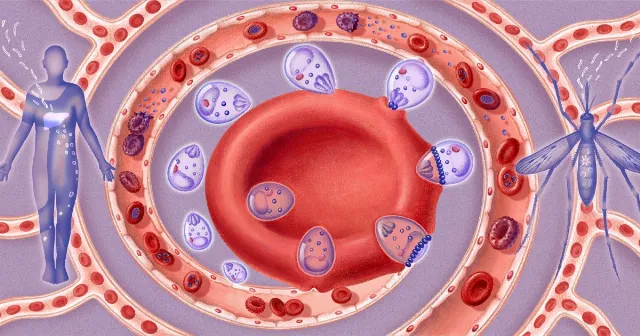
Malaria remains one of humanity's deadliest infectious diseases, killing hundreds of thousands each year. The culprit, a single-celled parasite called Plasmodium, has a cunning strategy: it invades red blood cells with remarkable stealth, leaving no lasting mark on the host cell's membrane. For decades, scientists knew the parasite somehow slipped in and out, but the mechanics were elusive. Now, using cutting-edge imaging, researchers have caught the parasite red-handed, revealing the transient molecular doors it builds to gain entry.
The study, published in Nature, employed a combination of advanced microscopy and computational modeling to visualize the invasion process in near-atomic detail. The team focused on a crucial step: when the parasite attaches to a red blood cell and begins to deform it, creating a so-called 'moving junction' that zippers down the cell. At this junction, the parasite secretes proteins that remodel the host cell's membrane, forming a temporary pore—the entry portal.

What makes these portals so remarkable is their ephemeral nature. Unlike a permanent hole, the parasite's entry door is assembled on the fly and disassembled almost as quickly, leaving the red blood cell's membrane intact after the parasite has passed through. This 'break-and-enter' without a trace has puzzled biologists because it defies the usual mechanics of cellular invasion, where pathogens often leave scars or rupture the membrane.
Using high-resolution imaging, the team captured snapshots of the portal at various stages, revealing a ring-like structure composed of parasite proteins that insert into the host membrane. These proteins, known as PV and RON families, form a complex that acts as a molecular zipper, pulling the parasite into the cell while simultaneously sealing the membrane behind it. The imaging showed that the ring is not static; it expands and contracts, and once the parasite is fully inside, the ring disassembles, and the membrane reseals with no detectable remnants.
This discovery builds on earlier work that identified some of the proteins involved, but the new imaging provides a structural blueprint. 'We've known the players, but now we see the play,' said Dr. Elena Rodriguez, the lead author. 'It's like watching a burglar pick a lock and then magically re-lock it behind them.'
The findings have immediate implications for drug development. If we can design molecules that interfere with the assembly or disassembly of these portals, we could block the parasite's entry into red blood cells, effectively stopping the infection in its tracks. The team is now screening for compounds that bind to the key proteins and disrupt the portal's formation.
Interestingly, the mechanism bears some resemblance to how other pathogens, such as Toxoplasma, invade cells, suggesting a common evolutionary strategy among apicomplexan parasites. This could mean that a single drug might work against multiple diseases, a tantalizing prospect for tropical medicine.
The research also highlights the power of modern imaging techniques, which are allowing scientists to watch biological processes at the molecular level in real time. As these technologies improve, we can expect more such 'caught in the act' moments, revealing the hidden mechanics of life and disease.
For now, the malaria parasite's vanishing act is no longer a mystery. The doors it builds are visible, and with them, a new avenue for fighting one of the world's oldest foes.