For decades, physicists have held a fundamental assumption about turbulence: in a swirling, chaotic fluid, energy cascades from large scales down to smaller ones, dissipating as heat. This one-way flow seemed as immutable as gravity. But a new study, inspired by the humble brine shrimp, has turned that notion on its head, revealing that a simple tweak can reverse the energy flow entirely.
The Classic Picture of Turbulence
In three dimensions, turbulence is everywhere—from the churning of a coffee cup to the roiling of a thunderstorm. The energy starts in big, lazy swirls and passes down to smaller eddies, eventually becoming so fine that viscosity turns it into heat. This cascade, first described by Lewis Fry Richardson and later quantified by Andrey Kolmogorov, is a cornerstone of fluid dynamics.
But in two dimensions, the story is different. Here, the energy can flow in the opposite direction—from small eddies to larger ones—a phenomenon known as an inverse cascade. This can lead to the formation of giant, long-lived vortices, like Jupiter's Great Red Spot. The rules governing this two-dimensional turbulence have been well studied, but they were thought to be fixed: energy always moves one way or the other, depending on the scale.
Sea Monkeys and a Surprising Discovery
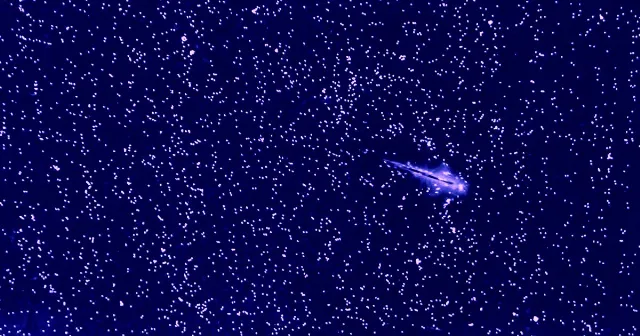
The breakthrough came when researchers decided to look at a real-world example of 2D turbulence: a swarm of brine shrimp, commonly sold as "sea monkeys." These tiny crustaceans create collective motion that mimics fluid flow. By carefully tracking their movements, the scientists noticed something unexpected: the direction of energy flow wasn't constant. It could flip, depending on how strongly the shrimp were interacting.
In a series of experiments, the team adjusted the density of the shrimp and their swimming speeds. At low activity, the energy flowed from small to large scales, as expected. But when they increased the activity, the flow reversed, sending energy from large scales down to smaller ones. This was a shock—no one had predicted that such a simple parameter could change the fundamental direction of energy transfer.
A New Rule for Turbulence
The discovery suggests that the rules of 2D turbulence are more flexible than previously thought. The key, the researchers found, is the ratio of two opposing effects: the tendency of swimmers to align with their neighbors (which promotes large-scale order) and the random, chaotic jostling (which breaks order). By tuning this balance, they could control which way the energy went.
This finding has implications beyond biology. It could help explain atmospheric and oceanic patterns, where 2D turbulence plays a role in weather systems and ocean currents. It might also inform our understanding of fluid dynamics in extreme settings, such as the behavior of accretion disks around black holes.
Implications for Physics and Beyond
The work is a reminder that even well-established theories can have hidden flexibility. "It's a beautiful example of how a living system can teach us something fundamental about physics," said one researcher involved in the study. The team hopes their findings will prompt other scientists to re-examine assumptions in their own fields.
For instance, the concept of energy cascades is not limited to fluids; it appears in mathematical models and even in computer simulations. If the direction of energy flow can be reversed in one system, perhaps similar reversals are possible in others.
The study also highlights the value of looking at nature for inspiration. "We often think of physics as being discovered in clean laboratories," said another scientist. "But sometimes, the messiest systems—like a tank of brine shrimp—can reveal the most profound truths."
What's Next?
The team is now planning to test their findings in other 2D systems, such as thin films of bacteria and vortices in superfluids. They also want to explore whether the reversal can be harnessed for practical applications, like controlling energy transfer in microfluidic devices.
For now, the discovery stands as a testament to the unpredictability of nature. As one researcher put it, "We thought we had turbulence all figured out. But the sea monkeys had other ideas."