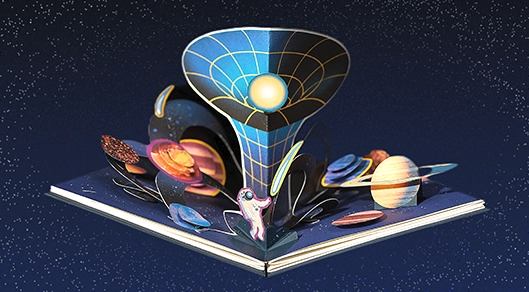
To make sense of the quantum world, physicists must abandon the familiar three-dimensional stage of everyday experience and step into an abstract mathematical landscape known as Hilbert space. This infinite-dimensional arena is where quantum states live, represented as arrows that rotate smoothly as systems evolve. The rules governing this space were codified by the mathematician John von Neumann, who laid down five commandments that dictate how quantum possibilities are encoded and how measurements collapse them into definite outcomes.
One of the most striking features of Hilbert space is its reliance on complex numbers—quantities that include the imaginary unit i (the square root of −1). These numbers allow for interference effects, where probabilities can cancel or amplify in ways that classical intuition would never permit. Yet, despite this exotic arithmetic, von Neumann's fourth commandment ensures that the odds of any event always emerge as a real, positive number, keeping the theory grounded in observable reality.
For some physicists, Hilbert space is more than a mathematical convenience; it is the fundamental theater of reality. Sean Carroll, a philosopher and physicist at Johns Hopkins University, argued in a 2022 paper that if quantum mechanics is the ultimate description of nature, then Hilbert space should be regarded as the basic arena in which the universe plays out. His research aims to derive our familiar world—with its particles, forces, and spacetime—from the bewildering structure of Hilbert space, which encompasses every conceivable way the universe could be.
But not everyone shares this grand vision. Jonathan Sorce, a physicist at Princeton University, takes a more pragmatic approach. For him, Hilbert space is a remarkably useful tool for describing many quantum systems, but it is not the be-all and end-all. Sorce is part of a community searching for a mathematical framework that can describe the fabric of space and time itself as a quantum object. Such a theory is essential for answering profound questions, such as what happens at the heart of a black hole.
In pursuit of these answers, researchers have turned to an even more abstract construction: von Neumann algebras. These algebras are built from the operations one can perform on a Hilbert space—like slicing it into subspaces or rotating one slice into another. They were originally developed by von Neumann himself, who famously confessed in a 1935 letter, “I would like to make a confession which may seem immoral: I do not believe in Hilbert space anymore.” He hoped algebras might resolve some logical inconsistencies he saw in Hilbert space.
Recent work suggests that von Neumann algebras are particularly suited for studying black holes. In this more flexible mathematical setting, black holes appear less mysterious, offering new insights into their quantum properties. Sorce, however, does not believe in a one-size-fits-all space. He is content to pick whichever construction best fits the problem at hand—sometimes a Hilbert space, sometimes a von Neumann algebra, and occasionally one of the many other exotic spaces mathematicians have devised.
“There’s a whole zoo of these things,” Sorce said. This diversity of mathematical structures reflects the richness of quantum theory and the ongoing quest to find the right language for describing nature at its most fundamental level. As physicists continue to probe the quantum nature of spacetime, the choice of mathematical arena may prove as crucial as the physics itself.