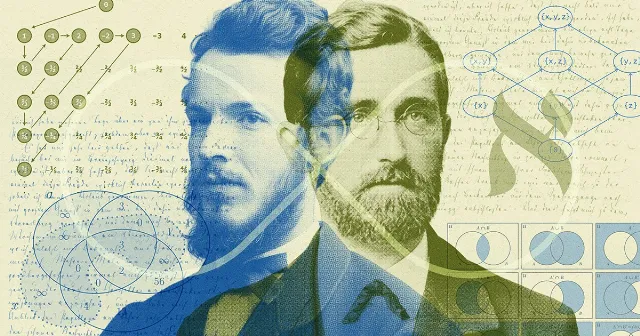
In the late 19th century, mathematics underwent a quiet revolution that would forever alter our understanding of the infinite. Georg Cantor, a German mathematician, published a paper in 1874 that demonstrated something astonishing: not all infinities are created equal. Some are larger than others, a concept that challenged centuries of mathematical and philosophical thought. This work laid the foundation for set theory and transformed how mathematicians approach fundamental questions about numbers and continuity.
A Discovery That Shook Mathematics
Cantor's breakthrough showed that while the set of natural numbers (1, 2, 3, ...) is infinite, the set of real numbers (including all decimals) represents a fundamentally larger infinity. He developed this idea through what became known as Cantor's diagonal argument, proving that no list of real numbers could ever be complete. This revelation was initially met with resistance from prominent mathematicians of his time, including his former mentor Leopold Kronecker, who famously declared "God made the integers, all else is the work of man."

The Uncomfortable Truth in Old Letters
Recently discovered correspondence, however, suggests a more complicated origin story for this mathematical revolution. The newly unearthed letters indicate that Cantor may have developed his ideas about different infinities after encountering similar concepts in the work of other mathematicians. While Cantor formalized and expanded these ideas into a comprehensive theory, the correspondence raises questions about whether he properly credited his intellectual predecessors.
The letters reveal a complex network of mathematical communication in late 19th-century Europe, where ideas circulated through personal correspondence long before formal publication. Several mathematicians were independently grappling with paradoxes of the infinite, and Cantor appears to have been aware of these parallel developments. The documents suggest he synthesized these scattered insights into a coherent framework without fully acknowledging their sources.
Why This Matters for Mathematics
This revelation doesn't diminish Cantor's achievement in creating a rigorous mathematical theory of infinite sets, but it does reshape our understanding of how mathematical breakthroughs occur. Rather than emerging fully formed from a single brilliant mind, Cantor's work appears to have been part of a broader intellectual movement. This pattern mirrors how abstract mathematics often develops through collaborative, if sometimes uncredited, efforts across generations of thinkers.
The controversy highlights the tension between individual genius and collective progress in science. Cantor undoubtedly made original contributions—he developed the diagonal proof, created transfinite arithmetic, and established set theory as a mathematical discipline. Yet the newly revealed correspondence suggests his starting point may have been less original than previously believed. This discovery reminds us that even in fields like mathematics, where ideas seem to emerge from pure logic, human factors like communication networks and professional rivalries shape the development of knowledge.
Infinity's Continuing Legacy
Despite these questions about its origins, Cantor's work on infinity has proven remarkably durable and influential. His ideas became foundational for 20th-century mathematics, influencing everything from the foundations of mathematics to computer science. The concept of different-sized infinities has found surprising applications in unexpected areas, much like how string theory draws on abstract mathematical concepts to attempt unification in physics.
The story of Cantor and infinity serves as a reminder that scientific progress is often messier than textbook narratives suggest. Great ideas frequently emerge from conversations, partial insights, and borrowed concepts that are then transformed through rigorous development. As historians continue to examine the newly discovered letters, they're not just rewriting the biography of one mathematician—they're revealing how mathematical revolutions truly unfold, through networks of thinkers building on each other's work, sometimes without proper acknowledgment.