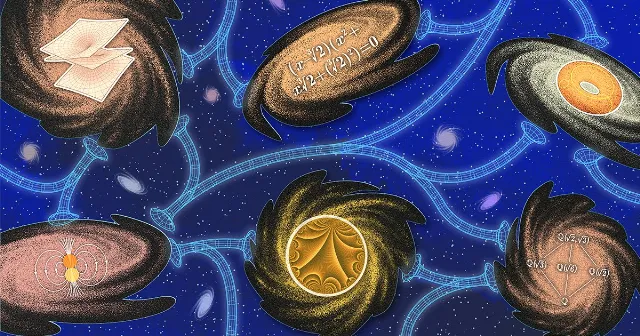
In the world of mathematics, some fields seem so detached from everyday experience that they appear to exist in a realm of pure thought. Category theory, born in the mid-1940s to formalize connections between mathematical constructs, has long been considered one of these most abstract domains. Yet a growing movement of researchers is now demonstrating that this very abstraction might hold unique power for understanding and improving our complex world.
From Pure Abstraction to Practical Tool
Category theory began as an effort to map the relationships between mathematical objects—things like numbers, functions, and sets. Its practitioners focus less on what objects are in isolation and more on how they relate to one another. As mathematician Tom Leinster illustrates, consider a chess king: its identity isn't in its physical form (wood or saltshaker), but in how it moves and interacts with other pieces on the board. This relational perspective is proving surprisingly versatile.

Over the past decade, what was once a niche area of pure mathematics has blossomed into "applied category theory," with over a hundred researchers joining the effort. The field now boasts its own conference, academic journal, research institute, and even government-funded programs. Despite this growth, practitioners often feel like underdogs in the broader mathematical community, facing skepticism about whether such abstract tools can meaningfully address concrete problems.
Modeling Complexity Through Relationships
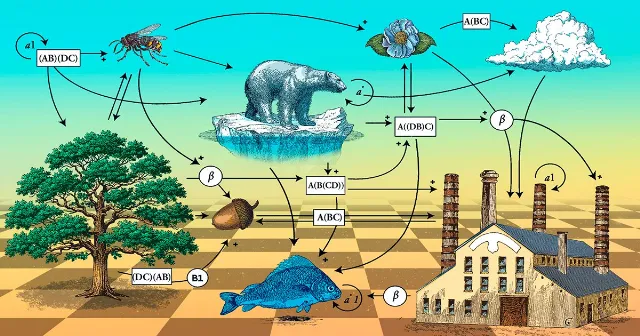
The central promise of applied category theory lies in its ability to model systems where relationships matter more than isolated components. Where traditional approaches might analyze individual elements, category theory provides a framework for understanding how those elements connect, interact, and influence one another. This makes it particularly suited for complex, interconnected systems that resist simpler analytical methods.
Researchers have begun applying this relational mathematics to surprisingly diverse domains. In epidemiology, category theory helps model how diseases spread through networks of human contact, capturing not just infection rates but the structure of social interactions. In artificial intelligence safety, it offers formal ways to reason about how AI systems make decisions and interact with their environments—a crucial concern as these systems become more integrated into society.
These applications represent a shift from the field's original aspirations. Early advocates like John Baez hoped category theory might become "green mathematics" that could directly address ecological crises by modeling complex systems like the biosphere. While that particular vision remains largely unrealized, the mathematics is finding traction in other critical areas where understanding relationships is paramount.
Connections to Natural Systems
The relational approach of category theory resonates with how many natural systems actually function. In biology, for instance, organisms aren't just collections of cells but complex networks where cellular interactions determine function and health. Similarly, patterns in living tissues emerge from physical relationships between components, not just their individual properties. Category theory provides mathematical language for these interconnected realities.
This mathematical framework also complements other approaches to understanding complex systems. Where physics might analyze cellular density through physical laws, category theory could model how density gradients affect cellular communication networks. The combination of different analytical perspectives—physical, biological, and mathematical—offers a more complete picture of nature's complexity.
The Future of Abstract Mathematics
The growing success of applied category theory suggests that even the most abstract mathematical idealizations can help make sense of messy realities. By focusing on relationships rather than isolated objects, researchers are developing tools that might eventually address some of our most pressing challenges, from pandemic preparedness to trustworthy artificial intelligence.
While the field continues to face skepticism from some quarters, its recent practical achievements demonstrate that the boundary between pure and applied mathematics is more porous than it appears. What began as an effort to formalize connections between abstract concepts is now helping illuminate connections in our world—proving that sometimes, the most powerful tools for understanding reality come from studying relationships themselves.