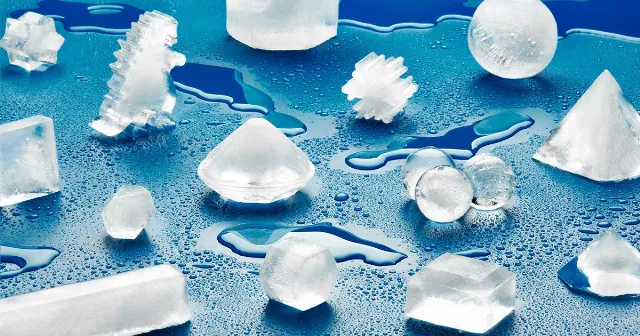
When you think of ice, the clear cubes clinking in your glass likely come to mind. But that familiar form is just one of many. Over the past century, physicists have discovered roughly 20 distinct phases of ice, each with its own bizarre properties—some are scorching hot, others bend like rubber, and a few can even conduct electricity. Now, cutting-edge simulations suggest that this list is far from complete; a veritable menagerie of exotic ices may still be waiting in the wings.
A Chilling Diversity
Ordinary ice, known as ice Ih, forms when water freezes at standard atmospheric pressure. But tweak the temperature or pressure, and water molecules rearrange into entirely different crystalline or amorphous structures. These phases, labeled with Roman numerals (ice II, ice III, and so on), exhibit startling behaviors. For instance, ice VII—found deep inside diamond anvil cells at pressures over 2 gigapascals—remains solid at temperatures above 100°C, earning the nickname “hot ice.” Meanwhile, ice XI is a ferroelectric phase that can hold an electric polarization, reminiscent of the way certain materials store data.
The discovery of these phases isn't just a curiosity; it has profound implications for planetary science. Many moons in our solar system, like Jupiter's Europa and Saturn's Enceladus, harbor vast subsurface oceans under thick ice crusts. The high-pressure ices that form in these alien environments could dictate the geology and even the habitability of these worlds. Understanding the full phase diagram of water is essential for modeling the interiors of icy moons and exoplanets.
Simulations Point to New Frontiers
Recent computational studies have pushed the boundaries of what we know. Using advanced molecular dynamics and machine learning potentials, researchers have predicted dozens of new ice phases that have never been observed in the lab. These simulations suggest that water can form complex networks of hydrogen bonds, leading to structures with intricate symmetries—some even mimicking the geometry of zeolites, the porous minerals used in industrial catalysis.
One particularly intriguing prediction is the existence of “superionic ice,” where oxygen atoms lock into a crystal lattice while hydrogen ions flow freely like a liquid. This phase, thought to exist in the interiors of Uranus and Neptune, could explain those planets' unusual magnetic fields. Experiments have already confirmed a superionic phase at extreme pressures, but the simulations hint at even more exotic variants with mixed ionic and electronic conductivity.
“We're only scratching the surface,” says Dr. Elena Voss, a physicist at the University of Cambridge. “Each new simulation reveals a potential ice phase that could exist under conditions we haven't yet explored in the lab. It's like discovering a whole new continent of materials.”
Why So Many Ices?
The key to ice's polymorphism lies in the water molecule's ability to form four hydrogen bonds—two as a donor and two as an acceptor. Under different pressures and temperatures, these bonds can bend, stretch, and reorient, allowing water molecules to pack into a dazzling array of arrangements. This flexibility is rare among simple molecules; most substances have only a handful of solid phases. Water's richness is a testament to the subtle interplay between quantum effects and classical forces.
Interestingly, the search for new ices has also shed light on the mathematical principles governing crystal structures. The symmetry groups that classify ice phases are identical to those used in abstract algebra, linking the physical world to pure mathematics.
What Lies Ahead
Experimental verification of these predicted phases remains a challenge. Creating the required pressures—often millions of times atmospheric pressure—and precisely controlling temperature is no small feat. However, new techniques like dynamic compression using high-powered lasers and advanced diamond anvil cells are pushing the envelope. The race is on to confirm the existence of the most complex ice yet.
If confirmed, these new ices could have practical applications too. For example, some predicted phases are expected to be excellent proton conductors, potentially useful in fuel cells or next-generation batteries. Others might serve as templates for designing novel porous materials for gas storage or separation.
As the simulations grow more sophisticated, they also raise deeper questions about the nature of water itself. Why does such a simple molecule yield such complexity? And what other secrets does it hold? For now, the hunt for new ices continues—a chilling reminder that even the most familiar substances can still surprise us.