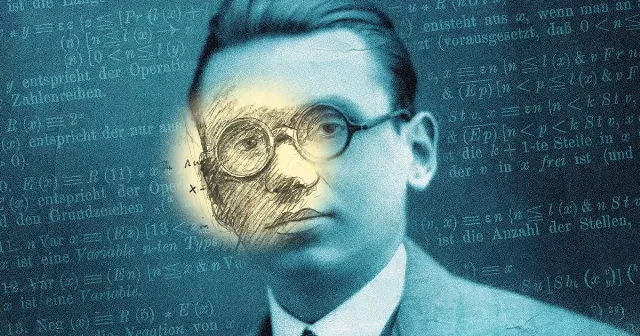
In 1931, at just 25 years old, Kurt Gödel delivered a blow to the foundations of mathematics that still reverberates today. His incompleteness theorems demonstrated, with ironclad logic, that no finite set of axioms can ever capture all mathematical truths. This isn't a temporary limitation—it's an inherent feature of any formal system rich enough to describe basic arithmetic. The implications extend far beyond mathematics, touching on philosophy, computer science, and even physics.
The Axiomatic Ideal
Since the time of Euclid, mathematicians have dreamed of building knowledge on a foundation of self-evident axioms—basic truths from which everything else can be logically derived. This approach reached its zenith in the early 20th century with Bertrand Russell and Alfred North Whitehead's monumental work, Principia Mathematica, which aimed to reduce all of arithmetic to logic. But even as they worked, cracks appeared. Russell himself discovered a paradox in set theory: the set of all sets that are not members of themselves. If it's a member, it isn't; if it isn't, it is. This contradiction shook the foundations of the field.
What Gödel Actually Proved
Gödel's first incompleteness theorem shows that in any consistent formal system that can express arithmetic, there will always be true statements that cannot be proved within that system. His second theorem goes further: such a system cannot prove its own consistency. In other words, mathematics is inherently incomplete. As philosopher Panu Raatikainen of Tampere University explains, 'The whole of mathematical truth concerning even just positive integers (1, 2, 3 …) is so perplexingly complex that it does not follow from any finite set of axioms.'
This means that some mathematical problems are not solvable by current methods, no matter how clever we are. Progress may require creative conceptual innovation—new axioms, new ways of thinking. As a result, mathematical truths do not form a unified, indubitable whole. Instead, they exist on a spectrum from rock-solid facts to increasingly speculative hypotheses.
The Contingency of Truth
One consequence of incompleteness is that the truth of certain statements depends on which axioms we choose to adopt. If a statement is undecidable in the standard axioms, we can add a new axiom to prove it true—or a different axiom to prove it false. This introduces a troubling contingency into what we call 'truth.' It's no longer absolute but depends on our preferences or assumptions. This has led some to question the very nature of mathematical reality: is mathematics discovered or invented?
Beyond Mathematics
Gödel's theorems have implications far beyond pure math. In computer science, they imply that no program can decide whether any given program will halt—the famous halting problem. They also cast a shadow on the dream of a 'theory of everything' in physics, suggesting that even our most fundamental theories may be incomplete. As philosopher Rebecca Goldstein notes, 'Intuitions have always played an important role in mathematics. After all, we can’t prove everything; we need to accept some truths without proof.' The theorems remind us that knowledge always rests on unprovable assumptions.
Recent developments in digital proof verification and ultrafinitism continue to grapple with Gödel's legacy. Some researchers explore whether AI can help discover new axioms or navigate the landscape of undecidable statements. Others, like those working on string theory, push against the limits of what can be proved.
Six decades after Nagel and Newman wrote that the meaning of Gödel's theorems 'has not been fully fathomed,' we are still uncovering their depth. They force us to confront the limits of formal reasoning and the creative, open-ended nature of mathematical discovery. In a sense, Gödel proved that mathematics will always be a journey, never a destination—a truth that is both humbling and exhilarating.