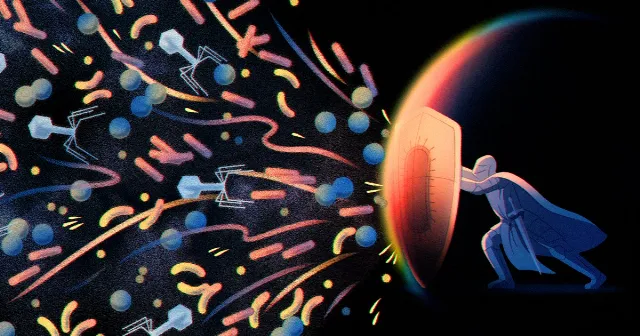
When you catch a cold or fend off a more serious infection, your body is deploying a defense system that traces its roots back billions of years—to the primordial struggles between bacteria and viruses. A wave of new discoveries is revealing that the very same molecular machinery that helped ancient microbes survive still operates within your cells today, shaping how your immune system recognizes and neutralizes threats.
For decades, scientists viewed the human immune system as a relatively recent evolutionary innovation, fine-tuned over millions of years in vertebrates. But recent research has uncovered a startling continuity: many of the proteins and pathways that form our innate immune response—the first line of defense against pathogens—are direct descendants of systems that evolved in bacteria and archaea. These ancient weapons, honed in the microscopic wars of Earth's early biosphere, have been co-opted and repurposed across eons of evolution.

One striking example is the family of caspases, enzymes that trigger programmed cell death to stop infections. Similar proteins appear in bacteria, where they act as a form of microbial suicide to prevent the spread of viruses. Another is the STING pathway, which detects DNA from invading pathogens; its origins lie in bacterial systems that sense foreign genetic material. These parallels suggest that our immune architecture is not a recent invention but a palimpsest of ancient molecular solutions.
The implications extend beyond pure curiosity. Understanding these evolutionary roots could lead to new therapies for autoimmune diseases, where the immune system attacks the body, or for enhancing responses to vaccines. For instance, by studying how bacteria regulate their defense systems, researchers might design drugs that dial up or down specific immune responses with greater precision.
This field, sometimes called evolutionary immunology, is also reshaping how we think about the tree of life. Rather than a clean hierarchy, it reveals a web of horizontal gene transfer—where genes jump between species—that has shuffled immune components across domains. Bacteria have swapped defense genes for eons, and some of those genes eventually found their way into our own genome.
For a deeper dive into how microscopic machinery reveals life's physical forces, check out Decoding the Bacterial Engine: How a Microscopic Motor Reveals Life's Physical Forces. And if you're curious about how other ancient systems influence modern science, String Theory's Resurgence: New Mathematical Evidence Revives the Quest for a Unified Physics offers a fascinating parallel in physics.
The next time your body fights off a virus, remember that it's wielding weapons forged in the crucible of early life. The immune system is not just a shield—it's a living fossil, a time capsule of billions of years of microbial warfare. And as scientists continue to decode its ancient origins, they are rewriting the story of how life on Earth learned to defend itself.