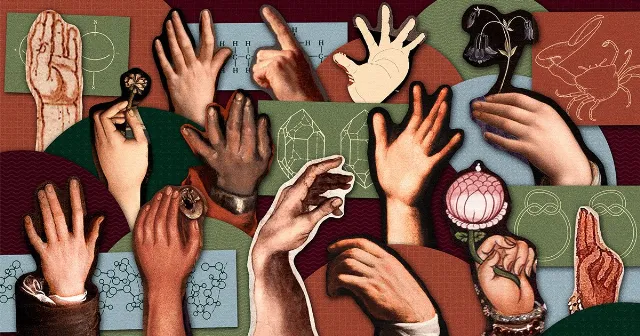
In philosophy, qualia describe the subjective essence of experience—what it feels like to see blue or taste chocolate. But for the roughly 10% of humans who are left-handed, there's a different kind of invisible difference: one that puzzles scientists across multiple fields. Why are most people right-handed, and why do some of us break the trend?
During a college semester in Ghana, I quickly learned that left-handedness carries social weight. Using my left hand to eat or pay was considered offensive—the left hand is traditionally reserved for hygiene tasks. When I asked my Twi instructor what happens if a chief is left-handed, he replied, “Oh no, no, we don’t go in for that.” Fortunately, the brain is plastic. I adapted, just as I learned to use scissors right-handed as a child. Today, I doubt I could cut with my left hand if I tried.
This adaptability reveals a deeper mystery: if handedness can be retrained, why does it matter which hand is dominant? And why are 90% of people right-handed? Researchers from genetics, developmental biology, neuroscience, and evolutionary biology have sought answers for decades. Recent discoveries are shedding new light.
First, left-handedness is not a mirror image of right-handedness. My internal organs are normally arranged—heart on the left, liver on the right—unlike the rare condition situs inversus. Brain lateralization is also more variable in left-handers. While most right-handers process language in the left hemisphere, left-handers show more diversity: about 70–80% still use the left hemisphere, but others use the right or both sides. This suggests a link between handedness and brain organization.
Genetics plays a role, but it's not deterministic. Two left-handed parents have a left-handed child only 25–30% of the time. Identical twins, who share the same DNA, show only a 20–30% concordance for handedness. This points to a mix of genetic predisposition and random developmental factors.
Another clue: the extreme rightward bias of human handedness is unique. Other mammals show paw preferences, but no species-wide imbalance like our 90-10 split. This suggests an evolutionary origin, perhaps linked to tool use or language.
Surprisingly, the causal arrow may not go from brain to hand. While it's natural to think that brain asymmetry determines handedness, recent research suggests the opposite: hand use shapes brain asymmetry. Our brains are sculpted by experience, and left-handers' brains reflect their lifelong adaptation.
As a group, left-handers are overrepresented among U.S. presidents, artists, musicians, and top athletes. This may reflect cognitive advantages, but the evidence is mixed. Some studies link left-handedness to creativity or divergent thinking, while others find no difference.
Ultimately, left-handedness remains a fascinating puzzle. It challenges our understanding of brain development, genetics, and evolution. And it reminds us that even in a world designed for the right-handed, diversity is the norm.