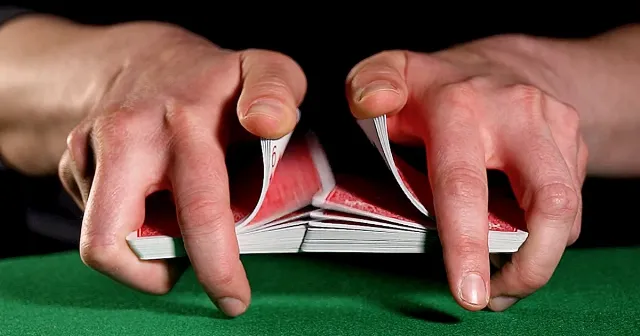
For decades, mathematicians have known that seven perfect shuffles are enough to thoroughly randomize a standard deck of 52 playing cards. But there's a catch: that result assumes you cut the deck with the precision of a professional magician, splitting it exactly in half every time. For the rest of us—whose shuffles are sloppy, uneven, or just plain lazy—the question has remained open. Now, a new proof provides an answer, and it's a satisfying one for anyone who has ever fumbled a deck.
The Perfect Seven
The classic result, proven in the 1990s, relies on a mathematical model of the riffle shuffle, where you interlace two roughly equal halves. When done perfectly—each half exactly 26 cards, and the cards alternating one from each half—seven shuffles suffice to erase any trace of the original order. This is known as the seven shuffles theorem, and it's a cornerstone of probability theory. But real-world shuffling is rarely so neat. Most people cut the deck unevenly, or the cards clump together, leading to a less efficient mixing process.
Why Sloppy Shuffles Matter
The new work, published by a team of mathematicians, tackles the messy reality of imperfect shuffling. Instead of assuming a perfect split, they model the cut as a random variable—sometimes you cut 20 cards, sometimes 30, and so on. The key insight is that the number of shuffles needed scales with the inverse of the square of the bias. In other words, if your cuts are off by a small amount, you need only a few extra shuffles. But if you're consistently cutting the deck into very unequal piles, you might need dozens, or even hundreds, of shuffles to achieve true randomness.
This isn't just a curiosity for card players. The mathematics of shuffling has deep connections to computer verification and algorithm analysis, where the mixing of data is crucial. The new proof also sheds light on the limits of human intuition: we often think a few quick shuffles are enough, but the math shows that even slight imperfections can dramatically increase the required number.
A Proof for the Rest of Us
The researchers used a combination of probability theory and combinatorial analysis to derive their result. They considered a general model where each shuffle involves cutting the deck into two piles of random sizes, then riffling them together. By analyzing the rate at which information about the original order decays, they found that the number of shuffles needed is roughly proportional to 1 / (p(1-p)), where p is the probability that a card from the top half ends up above a card from the bottom half. For a perfect shuffle, p = 1/2, which gives the minimal number. But as p deviates from 1/2, the required shuffles grow rapidly.
For a typical sloppy shuffle—say, cutting the deck into piles of 20 and 32—the effective p might be around 0.4 or 0.6. In that case, the new formula suggests you need about 10 to 15 shuffles to fully randomize the deck. That's a far cry from the magical seven, but still manageable for most people. However, if you're particularly clumsy and cut the deck into, say, 10 and 42 cards, the required number jumps to over 50 shuffles—a tedious task for even the most patient card player.
Implications Beyond Cards
The result has implications beyond card games. Shuffling is a metaphor for mixing in many scientific fields, from genetics to computer science. In biology, for example, the process of biological agency—how organisms mix their genetic material—involves similar randomness. The new proof provides a framework for understanding how much mixing is needed in systems where the process is imperfect.
The mathematicians hope their work will inspire further studies on real-world mixing processes, such as the diffusion of gases or the blending of fluids. As one of the authors noted, "Our proof shows that even small deviations from perfection can have large effects, but it also gives a precise way to quantify those effects." So next time you shuffle a deck of cards, remember: seven is for perfectionists. For the rest of us, a few extra shuffles are a small price to pay for true randomness.